玉观音
哪怕最小的选择,也会点亮整个大脑_我的网站

一 | 一项由国际合作团队创建的新小鼠脑数据集显示,决策过程会调动整个大脑的神经元活动。

二 |
“即便是可以说相对简单的决策,也会招募到非常多的大脑区域。”加州大学洛杉矶分校神经生物学教授、国际脑实验室(International Brain Laboratory,简称IBL)创始成员之一安妮·丘奇兰(Anne Churchland)说。

三 |
丘奇兰指出,传统的经典模型认为,基于视觉的决策活动路径是:从视觉丘脑传递到初级视觉皮层及其联络区,然后可能到达额叶皮层。但新的研究结果显示,“也许大脑中存在更多的并行处理,而不是我们原先以为的那种线性、逐层的电路结构。”
丘奇兰和其他科学家在2017年建立了IBL,这源于他们对以往小规模决策研究的挫折——那些研究往往一次只分析一两个脑区。
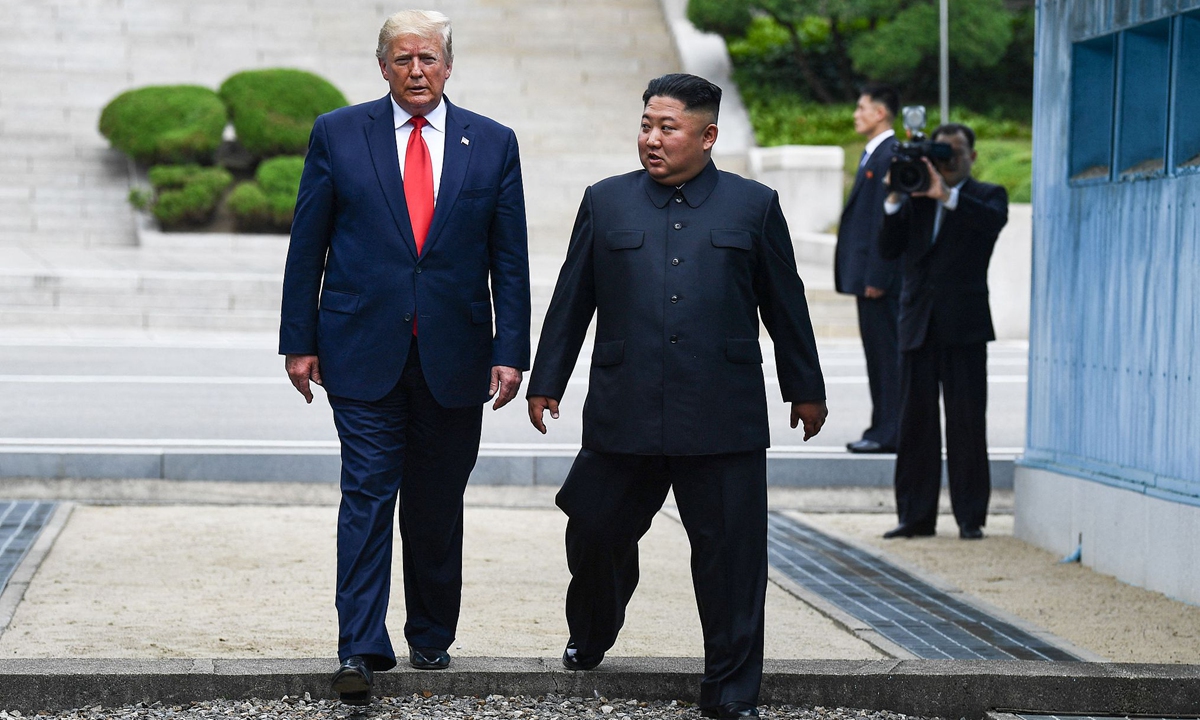
North Korea's leader Kim Jong Un and US President Donald Trump cross south of the Military Demarcation Line, after Trump briefly stepped over to the northern side, in the Joint Security Area (JSA) of Panmunjom in the Demilitarized zone (DMZ) on June 30, 2019. Photo: VCG
Just hours before a military exercise between the US and South Korea due to get underway on Monday, US President Donald Trump announced that Washington would reduce military exercises with key regional ally Seoul, citing his positive relationship with the North Korean leader and South Korea's lack of assistance with Iran, CNN reported.
Chinese experts see Trump's sudden decision to scale back military drills with South Korea as a signal of his intention to ease tensions on the Korean Peninsula and possibly return to direct diplomacy with Pyongyang. However, they warned that a carrot-and-stick approach may not work with Pyongyang, which has already seen Washington renege on its commitments. If Trump sincerely seeks peace on the peninsula, returning to the negotiating table with a genuine willingness to engage should be the first step.
Writing on Truth Social on Sunday, Trump said "based on my very good relationship with Kim Jong Un, of North Korea, I am not happy with the fact that the United States has, long ago, agreed to participate in Joint Military Exercises with South Korea."
"These exercises are not only costly, with much of these costs paid for by the United States of America (as usual!), but send a signal that is totally inappropriate and hostile, to a Country that, as long as Donald J. Trump has been President, has been unthreatening and respectful," wrote the US president, noting that since it was too late to cancel the exercises entirely, he had asked Defense Secretary Pete Hegseth to "substantially reduce" US participation.
The 11-day exercise, known as Ulchi Freedom Shield, was expected to involve about 18,000 South Korean troops. According to the US military, South Korean and US forces planned to conduct live-fire drills to test precision-strike and maneuver capabilities under complex operational scenarios, as well as river-crossing operations and the deployment of pre-positioned military supplies, South Korea's Chosun Ilbo reported.
Trump also reiterated his request for South Korea to help with the US war against Iran. "While somewhat unrelated, I recently asked the President of South Korea if they would like to join us in the Denuclearization of the Islamic Republic of Iran, and they said, 'No thanks!'" Trump wrote.
At a press conference of China's Foreign Ministry on Monday, a reporter also raised Trump's claim that he would scale back joint military exercises with South Korea, citing the high cost of the drills and his good relationship with North Korean leader, and asked how China would support the resumption of dialogue between the US and North Korea. Chinese Foreign Ministry spokesperson Lin Jian responded, "we have noted the relevant reports. Maintaining peace and stability on the Korean Peninsula and advancing the political settlement of the Korean Peninsula issue serve the common interests of all parties."
South Korean media Yonhap News Agency reported that Trump's instruction came as the situation on the Korean Peninsula remained tense again. The media noted that Trump's move can be seen as a conciliatory gesture toward the North Korea, after the White House repeatedly affirmed that Trump remains open to dialogue with Pyongyang "without any preconditions."
Trump has long sought to ease tensions on the Korean Peninsula, but his first-term diplomatic efforts produced few substantive results. The decision to scale back military exercises with South Korea may therefore signal an intention to send goodwill and return to direct diplomacy with North Korea, an unfinished piece of business from his first term, Song Zhongping, another Chinese military affairs expert, told the Global Times.
Long-standing tensions between the US and North Korea are a major source of instability on the Korean Peninsula, Lü Chao, an expert on East Asian studies at the Liaoning Academy of Social Sciences, told the Global Times, noting that the fundamental way to address these tensions is for the two sides to return to the negotiating table and resolve their differences through peaceful dialogue, rather than escalating tensions through displays of military force.
On August 13, a spokesperson for the Foreign Ministry of the Democratic People's Republic of Korea responded to the scheduled military drills between South Korea and the US. The spokesperson said that "it is our consistent principle of ensuring security to respond to a new level of a threat with a new level of a deterrent. DPRK remains steadfast in its will to frustrate outsiders' hostile acts with the most powerful and overwhelming force and absolutely defend the supreme interests of the state security," according to official Korean Central News Agency (KCNA).
On Saturday, Trump shared a photo of himself with Kim Jong Un, the top leader of the DPRK on Truth Social, and wrote that he and the North Korean leader "get along GREAT!"
During Trump's first presidential term, he and Kim first met in Singapore in June 2018, marking the first-ever US-DPRK summit. They met again in Hanoi, Vietnam in February 2019, and later that June in the inter-Korean border village of Panmunjom, according to Xinhua News Agency.
North Korea's past dealings with the US, particularly the breakdown of bilateral negotiations without substantial progress, have eroded Pyongyang's trust in Washington, Lü said.
Therefore, if Trump genuinely wants to leverage his relationship with the North Korean leader to address tensions on the Korean Peninsula, emphasizing their personal ties alone will not be enough. Washington will need to demonstrate genuine sincerity and back its words with concrete action, according to the expert.
。IBL的目标是大规模地研究大脑如何整合信息并做出决策。“我们组成了一个大型团队,因为大家都意识到,只有集体的努力才能在这个长期困扰我们的研究问题上取得突破。”丘奇兰说。
经过多年努力,IBL团队在12个实验室间统一了研究方法与设备,最终绘制出了小鼠在执行决策任务时的全脑神经活动图谱。

四 | 该图谱最近发表在《自然》[1]期刊上。结果显示,与选择和运动行为相关的神经活动几乎遍布整个大脑。同一团队发表的另一篇同期论文也发现,基于先验知识(prior knowledge)的决策过程同样涉及广泛的脑区[2]。
IBL的实验室通过整合来自139只完成视觉辨别任务小鼠的Neuropixels神经记录数据生成了这幅图谱。每个实验室记录的脑区不同,但合起来覆盖了整个大脑。最终的数据集跨越了近300个脑区,包含超过62万个神经元的活动,是目前关于决策过程最丰富的数据集之一。

五 | 未参与该研究的拉德堡德大学脑、认知与行为教授弗洛里斯·德·兰赫(Floris de Lange)评价道。
IBL已将该数据集公开[3]。

六 | 德·兰赫表示,这将让研究人员“能够以一种非常简便而强大的方式来检验新的科学假设”。
挑战传统观点
IBL选择了一种视觉行为任务——它足够复杂,可以揭示决策过程的不同方面,同时又足够简单,能够在不同实验室中重复实现。

七 |
在实验中,小鼠会看到一个带有黑白条纹的圆形图案出现在屏幕的左侧或右侧,然后它们需要转动一个微小的滚轮,将圆形移到屏幕中央。如果小鼠成功完成任务,就会获得一口水;如果失败,则会听到白噪声作为反馈。在此过程中,电极记录下小鼠从看到视觉提示、作出选择、转动滚轮,到最终获得水或噪声反馈时的大脑活动。
一旦动物看到视觉提示,大脑中一些可预测的区域(包括视觉皮层、丘脑和前额叶皮层)就会出现活动。
与选择相关的神经活动不仅出现在皮层区域(这与以往研究一致),还出现在下丘脑、后脑和小脑等皮层下区域。

八 | 这一发现挑战了“只有少数特定脑区编码决策信息”的传统观点,支持了“决策相关信息在大脑中广泛分布”的新理念。
“令人惊讶的是,几乎到处都能看到与选择有关的神经活动。”宾夕法尼亚大学的神经科学副研究教授Long Ding说道,他并未参与这项研究。
与运动和反馈相关的信号也遍布整个大脑:在记录的脑区中,有81%包含可以预测动物滚轮速度的信息;几乎所有被记录的脑区——包括那些与奖励无直接关联的区域——都能准确预测小鼠是否获得奖励,其中丘脑、中脑和后脑的活动最为强烈。
当小鼠在实验中更频繁地看到圆形出现在屏幕一侧时,它们会逐渐将这种“先验信息”融入下一次的决策之中。

九 | 研究团队在第二项研究中报告,这种信息广泛分布在大脑的20%至30%区域中,包括早期视觉通路中的感觉处理区域,如背外侧膝状体(dorsal lateral geniculate)。
这些发现推翻了长期以来的观点——即“先验信息”只会在最后一步才被整合到高级皮层或决策区的过程中。丘奇兰表示:“新的结果表明,先验信息在整个决策过程中都会发挥作用。”
总体而言,这些研究提示我们,目前关于决策机制及其控制脑区的模型可能过于局限,其他尚未探索的脑区也可能同样重要。
尽管分析表明,即使在感觉处理的早期阶段,大脑的分布式网络中也包含与决策相关的信息,但这并不意味着存在因果关系。

十 | Ding指出,未来的研究需要确定这些信息是如何被实际用于下一次决策或学习的。

十一 |
德·兰赫指出,这一详尽的脑图为后续实验奠定了基础,并可能成为一个“资料库”,帮助神经科学家在自己的实验室中验证结果。最终,这些研究强调了大规模、多实验室合作的重要性,尤其是在研究大脑活动时。
该国际合作组织如今已扩展至21个实验与理论神经科学实验室,并成立了一个名为IBL 2.0的新团队,计划与新的合作伙伴共享他们积累的工具与经验。丘奇兰表示:“我希望我们的研究能说明,当更多人联合起来时,他们能完成超越单个实验室能力的工作,并为整个领域带来关键性的洞见。

十二 | ”
参考文献:
[1] International Brain Laboratory., Angelaki, D., Benson, B. et al. A brain-wide map of neural activity during complex behaviour. Nature 645, 177–191 (2025).
[2] Findling, C., Hubert, F., International Brain Laboratory. et al. Brain-wide representations of prior information in mouse decision-making. Nature 645, 192–200 (2025).
[3] https://viz.internationalbrainlab.org/
原文:https://www.thetransmitter.org/decision-making/everything-everywhere-all-at-once-decision-making-signals-engage-entire-brain/
本文来自微信公众号:神经现实,作者:Claudia López Lloreda,译者:EY。
Current article:http://exgmyn.diuhuairandaikaomangshangnen.buzz/qfm2c/yhkspn.html
Published on:15:24:51

 581亿,北大校友又干出一个AI独角兽
 中国工信部:北斗在重点行业和大众应用场景加速拓展,中国工信部:北斗在重点行业和大众应用场景加速拓展
 冬奥冠军齐广璞:继续备战2026年冬奥会 希望更多年轻人爱上冰雪运动
 금리 오르는데 금값은 왜 뛰나
 沈腾《龙餐馆》13天票房破15亿 进入年度前五
 YouTube公布播放量统计新规:点击播放瞬间即计入观看次数
查看所有0条评论>>